

Floating Ads
Sterling City’s Weather of Want
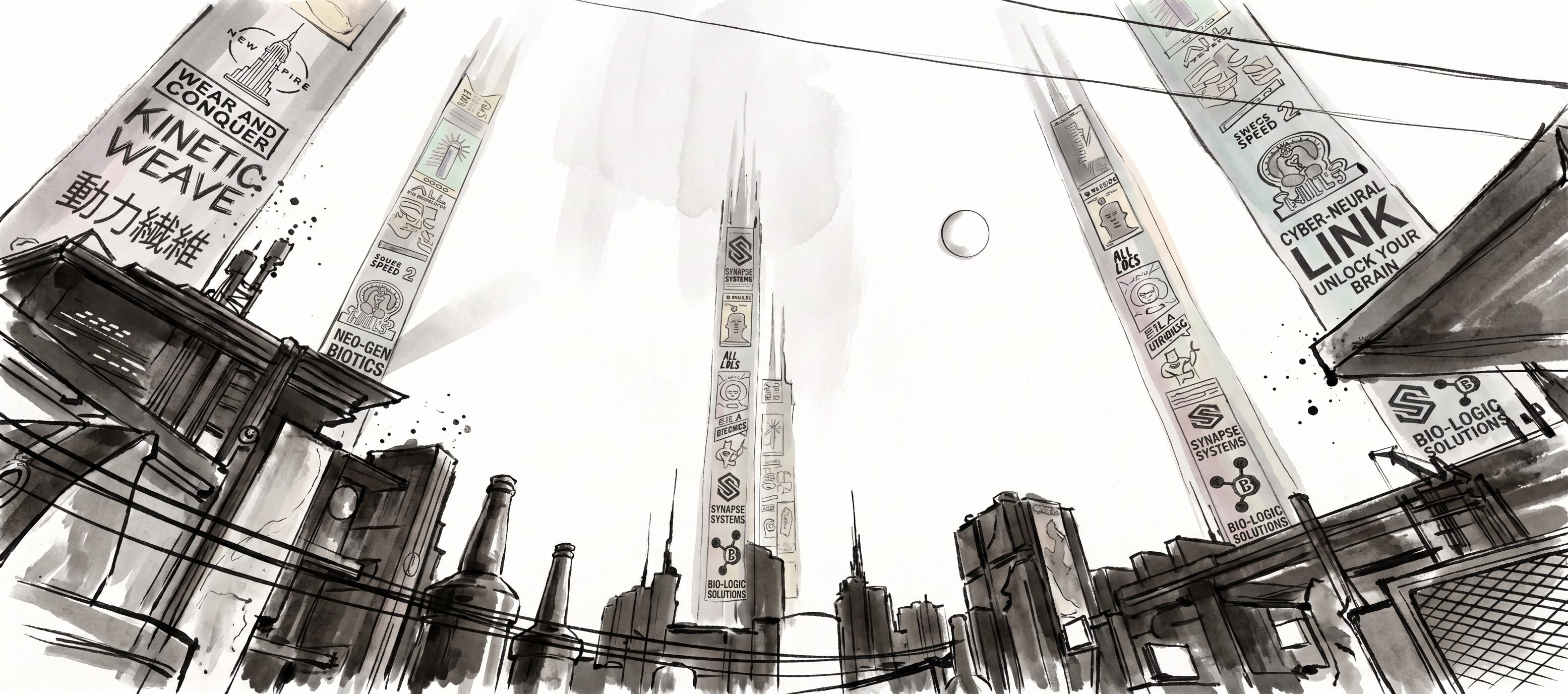
They called them floating ads, though nothing in Sterling City ever truly floated without a chain somewhere, and those bright, hovering ghosts that drifted between towers, clung to building faces, spilled across rain clouds, and lowered themselves over traffic like angels with corporate sponsors were less advertisements than atmospheric occupation, the city’s commerce made luminous and inescapable, each projection burning above the streets with the soft violence of a command disguised as invitation.
They were holograms, yes, in the plainest technical sense, shaped light rendered through drone lattices, tower projectors, embedded glass emitters, and atmospheric display fields seeded through the city’s busiest districts, but to anyone forced to live beneath them, they were the weather of capitalism, always descending, always watching, always whispering that the body was insufficient, the mind was outdated, the flesh was poor engineering, and salvation could be financed in monthly installments through one of Sterling City’s approved lenders.
A person could walk through Eastbay at three in the morning, soaked through from the bay rain and half-deaf from the freight yards, and still be lit from above by a thirty-story woman peeling synthetic skin from her shoulder as if unwrapping silk, smiling down with a mouth too perfect to belong to any living thing while a voice as warm as honey and as empty as a legal waiver promised dermal renewal, scar erasure, age correction, pigment customization, and the exquisite luxury of becoming someone no one had yet learned how to hate.
The Streetlight That Learned to Sell
Before the floating ads, the streets had ordinary signs, and ordinary signs, however bright, had the decency to remain attached to buildings, humming over noodle bars, weapon shops, clinics, pleasure houses, pawn stalls, and cheap sleep capsules like tired little gods with limited jurisdiction, but the corporations were never satisfied with surfaces they could not multiply, and in time every vertical space became available for purchase, every fog bank became a screen, every high window became a frame, and every pedestrian became an audience whether they consented to the performance or not.
The floating ads did not simply illuminate Sterling City; they edited it, painting over cracked concrete with impossible color, washing blood from alleys in perfume-pink glow, laying a soldier’s grin over the entrance to a discount cybernetics clinic, pouring blue-white pharmaceutical light across rain puddles where the unhoused slept under thermal sheets, and making even the worst parts of the city appear, for a few seconds at a time, like they might be on the verge of redemption if only someone nearby had the credits to buy it.
In rich districts, the ads were restrained, elegant, and almost ashamed of their own hunger, appearing as subtle glass figures in tailored suits, discreet product halos around private clinics, fragrance-soft invitations to longevity treatments, genetic refinement, memory therapy, and concierge security systems that promised protection without ever naming the people one needed protection from, while in the lower districts the ads became louder, closer, and more desperate, shouting over train noise, rain, sirens, and hunger with weapons demonstrations, stimulant patches, pleasure implants, loan offers, synth-skin rebates, and cybernetic upgrades bright enough to burn themselves into the backs of tired eyes.

What They Sold
The floating ads sold everything the city had already convinced its people they lacked, and because Sterling City was built on lack, on the careful manufacture of insecurity, pain, envy, fear, and desire, there was never any shortage of product.
They sold the latest handguns with recoil correction and biometric loyalty locks, sleek little things rotating in midair above commuter lanes while smiling models fired into abstract silhouettes made of red light, and they sold heavier weapons behind softer language, personal defense platforms, tactical household protection, executive-grade deterrence, each phrase polished until the violence beneath it looked like responsibility.
They sold synth skin in every shade and texture the human imagination had been trained to covet, poreless, scarless, sweat-responsive, age-adjustable, velvet finish, glass finish, sun-kissed finish, corpse-pale aristocrat finish, marketed to the wealthy as aesthetic sovereignty and to the poor as one more way to look employable, desirable, less wounded by the life that had already marked them.
They sold cybernetics for labor, cybernetics for status, cybernetics for beauty, cybernetics for pain management, cybernetics for war, and cybernetics for sex, though the last category was always phrased with the practiced delicacy of companies that wanted profit without embarrassment, promising enhanced intimacy, partner-responsive sensory suites, stamina regulators, neural pleasure tuning, pelvic actuator refinements, tactile amplification, hormonal synchronization, and discreet upgrades for customers who wanted their private appetites engineered as carefully as their public faces.
The ads did not care whether the viewer was lonely, injured, aging, frightened, ashamed, or broke, because the system had already learned that all of those conditions could be translated into demand, and the holograms were tireless in their mercy, forever offering a newer body, a sharper weapon, a cleaner face, a stronger spine, a better lover, a calmer mind, a longer life, a sweeter mouth, a harder fist, and a version of the self that could survive the city because it had finally become expensive enough to matter.
How They Watched
The floating ads were never only displays, because in Sterling City anything that spoke to the public also listened to it, and every glowing woman selling synth skin, every rotating rifle over a traffic jam, every haloed clinic logo drifting above a crowded plaza carried within it a quiet appetite for data.
They tracked gaze duration, pupil dilation, facial tension, gait instability, biometric stress markers, purchase history, district origin, social score, debt status, medical subscriptions, known affiliations, and the thousand little betrayals of the body that told the market what a person wanted before that person had gathered the courage to want it openly.
A man who paused too long beneath an ad for military-grade prosthetics might find discounts following him for weeks, flashing in train windows and bathroom mirrors and the corner of his work terminal, while a woman whose hand drifted unconsciously to a burn scar beneath her collar might be pursued across three districts by soft-voiced offers for skin replacement plans and compassionate financing, and a lonely executive leaving the 9th Ward before dawn might have his private implants politely suggested for recalibration before he even reached his waiting AV.
Nothing in Sterling City was more intimate than advertising, because the ads saw people in the moment before they became decisions, when longing was still shapeless and shame had not yet named itself.
What They Meant
For the corporations, floating ads were public infrastructure, economic vitality, ambient engagement, and brand visibility, all those clean phrases that made occupation sound like service, but for the people below, they were reminders that the city’s eye did not blink, that even darkness had been monetized, and that privacy was not the absence of surveillance but merely the luxury of being watched by systems too expensive to announce themselves.
Children learned to read by sounding out weapon slogans on the sides of towers, lovers kissed under the glow of fertility clinics and neural-link promotions, addicts slept beneath stimulant ads promising focus without collapse, and the dead were sometimes found in alleys washed blue by holographic doctors who smiled down and promised renewal with impossible tenderness.
The ads made Sterling City beautiful in the cruelest way, because they gave the streets light without warmth, color without mercy, and dreams without any promise that waking would be survivable.
And still, when the rain came down hard and the bay fog rolled in thick enough to swallow the skyline, the floating ads remained, drifting through the mist like corporate spirits that could not be exorcised, selling better bodies to broken ones, selling pleasure to the lonely, selling weapons to the afraid, and selling the future to a city that had already spent its soul trying to afford the present.
