

El Pacifico
Where Belonging Outlives the City

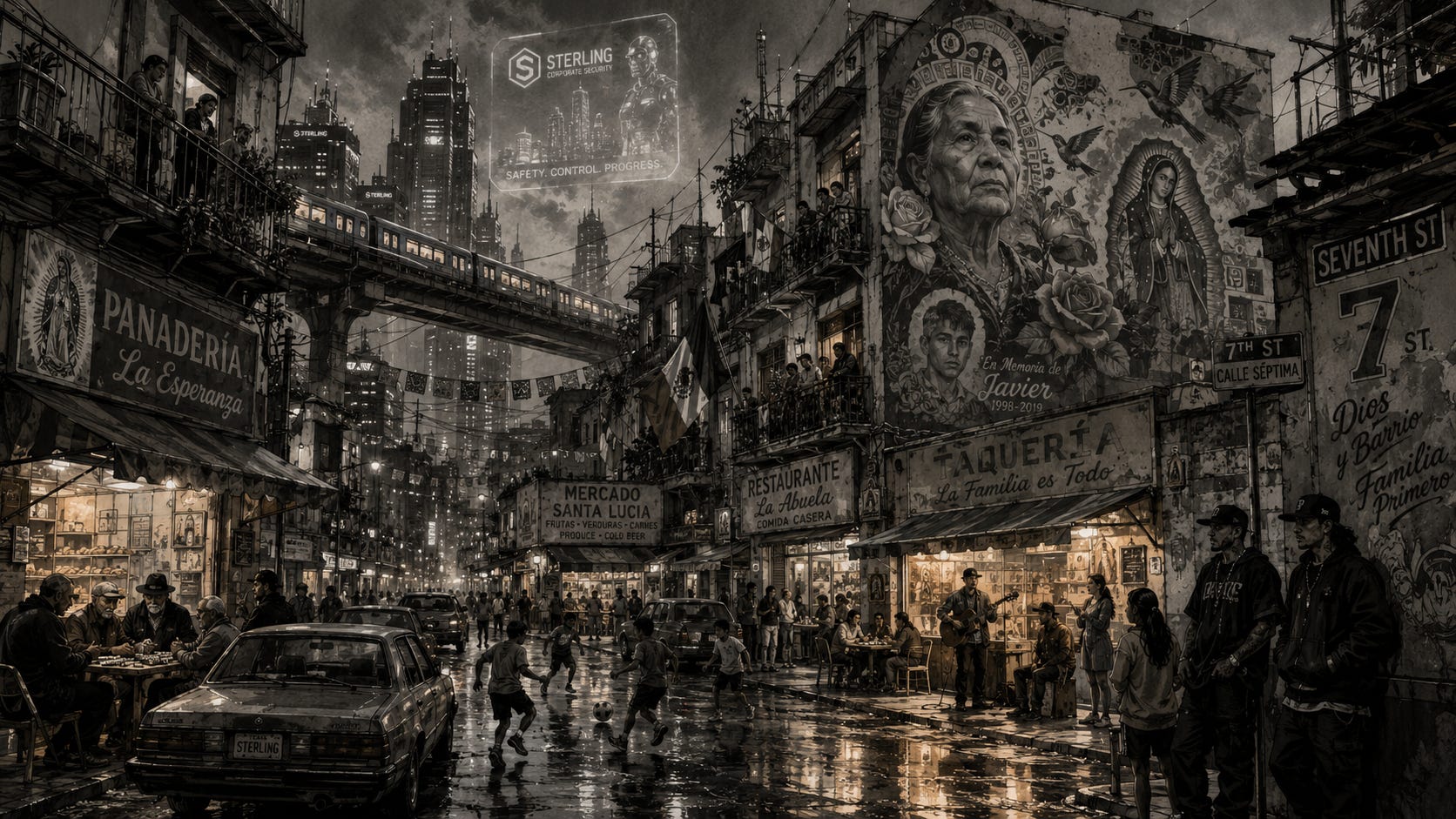
They called it El Pacifico, though no one could quite remember why anymore, because there was no Pacific Ocean anywhere near Sterling City, only the old Chesapeake Bay breathing against seawalls and shipping lanes on the opposite side of town. Some said the name came from the first generation of immigrants who had crossed half a continent before finally settling there, carrying memories of another coastline they refused to surrender. Others claimed it was irony, because there had never been much peace in El Pacifico. Like most stories in Sterling City, the truth had been buried beneath enough years to become folklore.
El Pacifico was the city’s largest Hispanic neighborhood, a dense, living district where Spanish drifted through the streets as naturally as English, sometimes blending together in the same sentence until outsiders could no longer tell where one language ended and the other began. Families lived shoulder to shoulder in aging apartment blocks painted in impossible colors, balconies overflowing with laundry, flowers, religious icons, and flags faded by decades of summer heat. The buildings leaned toward one another as though the entire neighborhood had decided long ago that survival required closeness.
It smelled like food before anything else.
Fresh tortillas puffing on hot griddles before sunrise. Carne asada smoking over charcoal behind family restaurants. Cilantro, roasted peppers, citrus, garlic, sweet bread cooling behind bakery windows, coffee strong enough to wake an entire block, and on weekends the unmistakable perfume of street vendors grilling corn while children chased one another between folding tables covered in handmade jewelry, embroidered clothing, bootleg electronics, and secondhand cybernetics waiting for someone desperate enough to believe they still had another decade left in them.
The corporations called El Pacifico underdeveloped.
The people who lived there called it home.
The Murals
Nearly every wall carried paint.
Not graffiti in the careless sense outsiders imagined, but murals that stretched across entire buildings, telling stories too large for paper to leave inside history books. Saints watched over intersections. Revolutionary figures stood beside neighborhood grandmothers. Children lost to gang violence smiled forever beneath impossible blue skies. Flowers climbed concrete walls beside skeletal saints wearing gold crowns. Jaguars, eagles, roses, hummingbirds, and Aztec patterns flowed together into paintings so large that they seemed less like decoration than memory itself refusing to disappear.
Every mural had someone who remembered helping paint it and why, celebrations or funerals, oftentimes, both.
The Music
Silence never lasted long in El Pacifico.
Music leaked through open apartment windows before dawn, spilled from restaurants into the sidewalks, echoed beneath elevated rail lines, and drifted through neighborhood parks where old men played dominoes beneath the shade while arguing about baseball, politics, and which generation had ruined the world this time.
Mariachi still had a place here, its bright brass and aching violins rising in long, winding phrases that seemed to carry entire histories in a single breath, weaving through the streets with a kind of stubborn grace that refused to fade even as the city changed around it, and cumbia moved alongside it in slow, swaying rhythms that rolled like a tide through crowded rooms and open sidewalks alike, drawing bodies into motion with a pulse that felt both ancient and immediate, as though time itself had learned to dance and never quite stopped.
So did reggaeton, Latin trap, salsa, norteño, corridos, bachata, hip-hop, electronic remixes stitched together by teenagers with secondhand decks and more ambition than credits.
Someone was always playing something.
A birthday unfolding in laughter and candles and voices rising together beneath strings of lights, a wedding spilling into the street with music that refused to stay contained, a cookout stretching long into the evening with smoke curling upward as stories grew louder and warmer, a memorial where grief and song braided together until sorrow itself seemed to hum with memory.
In El Pacifico, music was rarely entertainment alone. It was proof the neighborhood was still breathing.

The Seventh Street Gang
The Seventh Street gang controlled El Pacifico, and everyone from police to City Hall to corporations, knew it.
Even tourists who wandered into the district by accident figured it out before they reached the second intersection, because respect announced itself differently here. Young men leaned against storefronts without appearing idle, older women greeted them by name on their way to the market, restaurant owners slipped plates of food across counters without charging them, and children waved without fear because they had grown up recognizing the difference between their protectors and everyone else’s.
To the rest of Sterling City, Seventh Street was a gang, a word spoken with the easy certainty of distance, flattened into statistics and headlines that reduced lives to numbers and danger to something abstract and manageable from afar, but inside El Pacifico the truth unfolded in slower, more complicated currents, where the same hands that could close into fists were just as often extended in quiet acts of care, settling disputes before anger could harden into gunfire, walking elderly residents home through streets that felt safer in their presence, paying utility bills for widows who had slipped silently into hardship, gathering money for funerals when institutions failed to show up, driving away dealers who tried to sell poison to neighborhood children without permission, and hunting down predators the legal system had forgotten, even as, in darker moments that no one denied and no one could fully excuse, they themselves became the danger they claimed to hold at bay.
That contradiction sat at the heart of El Pacifico like an old scar everyone had learned to dress without pretending it wasn’t there.
Protection always came with a price.
The neighborhood simply believed it was paying less than it would elsewhere.
Loyalty
People born in El Pacifico rarely left willingly.
Not because they lacked opportunity, though many did, but because belonging carried a value difficult to explain to people raised inside the polished isolation of the Trident or the careful distance of Corpo Centre. Here, neighbors knew birthdays, funerals, first jobs, divorces, addictions, recoveries, pregnancies, and who needed groceries without being asked.
A grandmother could scold someone else’s grandson from across the street without causing offense.
A child could knock on almost any apartment door when frightened.
An entire block would appear with folding tables and homemade food if someone lost a loved one.
People argued with a volume and intensity that seemed to shake the very walls around them, voices rising and overlapping in passionate bursts that carried equal parts frustration, love, and history, and yet those same arguments lingered in the air long after they ended, settling into a silence that stretched not with indifference but with the slow, deliberate work of forgiveness, because grudges here were not easily discarded but carefully worn down over time, shaped by memory into something that could eventually be set aside without ever being forgotten, for nothing in El Pacifico truly disappeared, not the hurts, not the joys, not the names or the stories, all of it held close and carried forward, woven into a sense of family that extended far beyond bloodlines into something broader and more enduring, a network of obligation and care that outsiders might dismiss as inefficiency but which the neighborhood understood, in its bones and in its daily rituals, as the only reason it had survived at all.
The Streets
The neighborhood was dense enough that sunlight sometimes struggled to reach the pavement between older apartment buildings, yet life spilled into every available space regardless. Sidewalk cafés claimed parking spots. Mechanics repaired vehicles with doors rolled open into the street. Vendors unfolded carts wherever enough pedestrians gathered. Kids played soccer in narrow alleys until someone shouted that a car was coming, scattering just long enough to let traffic crawl past before reclaiming the pavement.
Power lines crisscrossed overhead in tangled webs that looked as though they had grown instead of being installed.
Colorful banners stretched between buildings during festivals.
Strings of lights remained hanging long after the celebrations ended because no one saw much reason to remove them.
Even at midnight, the neighborhood refused to surrender itself to silence, instead lingering in a slow, luminous wakefulness where voices drifted through the warm air in overlapping currents of conversation, laughter rose and fell like a tide that never quite receded, and life itself continued to unfold in small, unhurried gestures; people leaning in doorways, sharing stories, passing food, watching the night breathe around them as though the simple act of remaining present together was both defiance and devotion, a quiet insistence that El Pacifico would keep living long after the rest of the city had gone to sleep.
What the City Could Not Measure
The city liked to measure neighborhoods by tax revenue, property values, crime statistics, and investment projections.
By those measurements, El Pacifico always appeared to be falling behind.
What those numbers never captured was how fiercely the neighborhood refused to disappear.
Every generation arrived carrying predictions that the district would finally be swallowed by redevelopment, pushed aside for luxury towers, biotech campuses, executive housing, or another polished corporate vision of progress. Every generation watched investors buy buildings around the edges, waiting for property values to climb high enough to force everyone out.
And yet, with a quiet, stubborn persistence that felt less like resistance and more like an inheritance passed hand to hand, every generation remained, not because life there unfolded easily or safely, but because something deeper had taken root, something that bound people to place with a strength that could not be measured in profit or risk, until memory itself had seeped into the walls and streets and structures, becoming indistinguishable from the architecture that held them, so that the murals did not merely decorate but remembered, the restaurants did not simply serve but remembered, the churches did not only gather but remembered, and the music, drifting endlessly through the air, carried remembrance in every note.
Even the cracked sidewalks seemed to remember every wedding procession, every funeral march, every protest, every festival, every child who had learned to ride a bicycle beneath strings of colored lights while grandparents watched from folding chairs with coffee in one hand and impossible optimism in the other.
Sterling City had spent decades convincing its people that everything could be bought, sold, upgraded, leased, demolished, and rebuilt into something more profitable.
El Pacifico remained one of the few places stubborn enough to answer with something the corporations had never learned how to manufacture.
Belonging.

The shadows of Sterling City whisper your name. Subscribe to Black Petal and let the secrets unfold in your inbox.
