

Chapter 5: Beautiful Errors
The Dollhouse

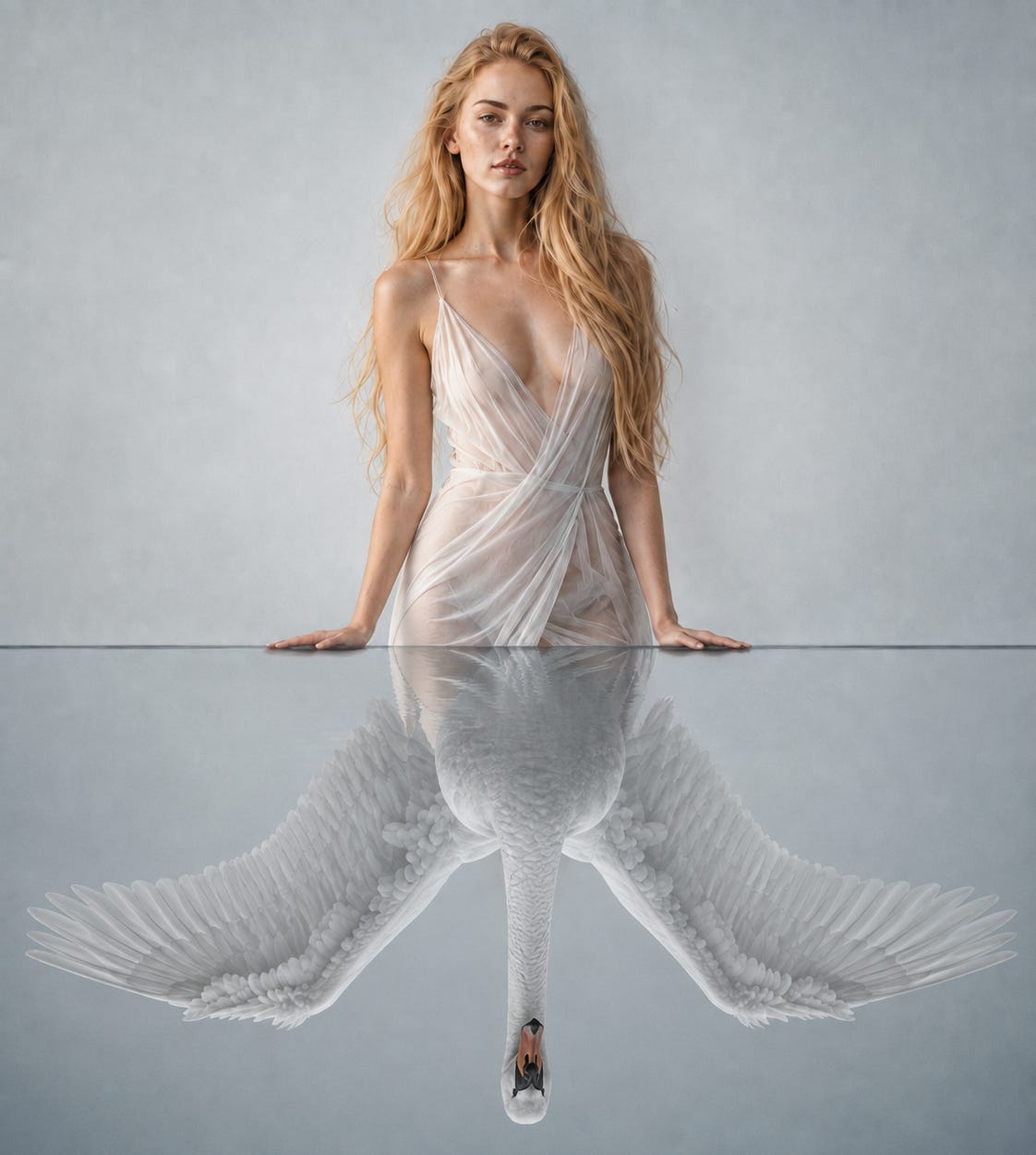
Leon stood before the suspended flower and counted the petals again, not because the number had become difficult but because some stubborn, well-trained part of his mind refused to accept that the answer could remain wrong after being inspected twice, his gaze traveling around the translucent sculpture while pale gallery light moved through the data glass and fractured along its edges, turning each petal into a different shade of cold color above the shallow black pool beneath it.
Five petals. He counted them, solid and real.
Then he looked at the mirrored wall.
In the glass, six.
Leon shifted several feet to the left, watching the reflected perspective adjust exactly as it should, the flower rotating against his changing angle, the black pool stretching beneath it, the emergency lighting sliding across the reflected floor in perfect obedience to geometry, and yet the sixth petal remained attached to the reflected bloom as naturally as if it had always belonged there. He crouched and looked upward from near the floor, then rose and walked almost to the edge of the pool, close enough that the reflected flower seemed suspended directly above his own head, but no matter where he moved, the impossible petal survived the correction.
It was not a glitch.
He crossed toward the mirrored wall with one hand already lifting, expecting projection glass, augmented optics, some concealed display layer laid over the reflection, anything that would reduce the impossible object back into a system he understood, when Cygne’s voice drifted through the darkened gallery behind him with the same delicate calm she had carried among the patrons.
“You found an error and immediately assumed something was broken.”
Leon turned toward the voice, finding her nowhere at first, only the pale architecture repeating itself through black glass.
“Mirrors do not invent objects.”
“Neither does code.”
The answer wasn’t profound, but it was technical and that was enough to strip the mystery from what he was seeing. As he looked back at the flower, the problem quietly rearranged itself inside his head. He hadn’t been trying to fix a broken object; he had been asking the wrong question entirely.
Where was the data hidden?
He had approached the gallery from the beginning as a locked room, searching for a private partition or a hidden server. He assumed the signature was contraband stored inside. But if the physical gallery and its reflection were supposed to be identical, yet differed, then he wasn’t looking at one environment with a malfunctioning mirror.
It was two versions of the same file.
Leon stared into the reflection and mentally reduced everything around him into datasets, the physical room becoming one system image and the mirrored room another, and the logic returned so naturally that he almost resented himself for not seeing it sooner. When two supposedly identical images differed, he did not need to interrogate every line of both systems and drown beneath the volume. He needed the delta.
The difference.
He stopped searching Cygne’s servers and began searching for her mistakes.
Leon moved through the gallery again, slowly now, entering each room as if it were evidence he had contaminated the first time by looking at it too casually, and instead of studying what the artwork depicted, he compared the thing itself with the thing the mirrors claimed it was.
The errors were everywhere.
In a painting of Sterling City’s skyline, he counted nine illuminated windows on the physical canvas but only eight in its reflection. A long dining installation of seven chairs gained an eighth ghostly guest in the mirror. He had to stand directly across from one doorway to notice its reflection had shifted several centimeters, the asymmetry otherwise disguising itself as perspective. Overhead, a suspended installation of thin crystal lights was complete, but the mirror showed one crystal missing. A projected portrait whose subject looked slightly left now stared directly outward from the reflected wall, its intimacy making Leon feel watched.
None of it announced itself.
That was the elegance of it.
Cygne had not filled the gallery with riddles begging to be solved, because riddles made people suspicious, and suspicion ruined concealment. The differences were small enough that the human mind corrected them before conscious thought could object, beauty smoothing over the contradiction the way expensive tailoring concealed a scar, and Leon understood with growing irritation that the artwork itself was doing half of Cygne’s work for her.
“You’re exploiting visual correction,” he said when he finally found her standing near the edge of another mirrored chamber, pale gown almost dissolving into the low light.
Cygne did not deny it.
“People forgive beautiful things much faster than ugly ones,” she said, her gaze wandering toward the suspended crystal installation. “A cracked industrial display gets inspected because everyone expects failure from it, but hang something priceless in a white room and give it enough light, and suddenly every wrong angle becomes intention, every missing line becomes taste, every impossible reflection becomes something clever enough to discuss over wine.”
Her eyes returned to him.
“The safest secret is the one everyone has already seen.”
This time Leon understood that she meant it literally.
Every patron who had walked through the gallery had looked directly at fragments of the route his stolen identity had taken, had photographed pieces of it, admired it, stood beneath it, perhaps complained about it to friends afterward, and none had known they were looking at data.
He returned to the maintenance terminal, fingers flying across the projected keys. Six petals, eight windows, eight chairs, one light; the numbers became strings, then coordinate pairs. He forced them through Trident’s native encoding, then two older schemes that persisted in the city’s digital ghosts. Each time, the terminal returned only corrupted symbols. He reordered the sequence, driving the data through the same logic gates. The result was the same: a wall of digital noise.
Across the room, Cygne had settled quietly into a dark corner, watching without interrupting.
“You said the discrepancies were the message.”
“I said no such thing.”
Leon looked up sharply.
Cygne’s expression remained serene.
He turned back toward the numbers and felt the structure beneath the problem shift again.
The discrepancies were only one layer.
The gallery had several.
Then he remembered the music.

The string composition had changed whenever patrons moved through the exhibition, which he had dismissed as adaptive ambience because rich people liked buildings that reacted to them, but now he left the terminal and returned to the audio chamber without touching the controls.
He listened.
With the gallery empty, the composition had simplified into a repeating sequence, low cello beneath sparse violin and delicate plucked strings, each phrase returning to itself with almost mathematical patience.
Leon walked into the central flower chamber.
The cello changed.
One sustained note descended beneath him, almost too subtle to notice.
He stepped back into the corridor.
The original sequence returned.
Leon walked toward the dining installation with the extra reflected chair, and this time a violin note sharpened above the cello, holding for precisely the length of his presence before falling away when he left.
He began moving between every room containing a discrepancy, and each answered differently, some with a changed pitch, some with altered duration, some with a plucked note inserted where silence had existed before.
Leon stopped in the corridor and listened to the composition rebuilding itself around his movement.
The visual errors were the data.
The music told him their order.
Cygne had split the message across senses so that seeing alone produced fragments and hearing alone produced structure without meaning, while only someone capable of understanding both would ever realize they belonged together.
Leon reordered the numbers according to the musical sequence and fed them back through his calculations.
Garbage.
He closed his eyes for a moment, fingers pressing briefly against the bridge of his nose, then opened them and looked beyond the artwork toward the rooms themselves.
The architecture.
He crossed to the public gallery map mounted beside the stairwell and studied the floor plan, noticing for the first time that the exhibition chambers formed a clean geometric arrangement around the central flower room, each black mirrored wall dividing space along deliberate directional axes.
Leon began testing the idea almost before he had fully articulated it.
An object appearing only in reflection could represent addition.
Something missing from reflection could mean subtraction.
A discrepancy displaced left or right might reverse or preserve the direction of the sequence.
He finally saw the whole system. The artwork provided the values, the music gave him their order, and the architecture itself was the operator, dictating how each piece of data should act upon the next.
Leon stared at the map, then back into the gallery, and despite himself a quiet laugh left him.
“You’re brilliant.”
Cygne appeared at the threshold behind him.
Leon looked around at the mirrors, the sculptures, the silent speakers hidden inside the architecture, every piece existing openly where anyone could see it.
“You made the entire gallery the key.”
“No.”
Cygne’s gaze traveled through the rooms as though she were admiring them for the first time.
“I made the gallery the message.”
Leon went through everything again, methodically now... the orientation of each room told him how the numbers should turn against one another. Slowly, the final sequence resolved, not as raw data, but as alphanumeric characters from a common routing index. The meaningless string collapsed into something readable.
Not his identity signature…A destination.
GLEN OAKS.
Then another line resolved beneath it.
BLACK PINE ROAD.
Leon checked the result once, then again, changing the assumptions deliberately to see whether the solution would survive scrutiny, but it held.
He looked toward Cygne.
“My signature isn’t here.”
“No.”
“Where is it?”
“It passed through my hands.”
“Just like Corvus.”
Cygne’s faint smile answered before her voice did.
“I do not keep something that valuable sitting inside a gallery.”
Irritation rose hot through Leon’s exhaustion, yet beneath it something colder had already begun arranging the last several hours into a pattern he did not like, because Corvus had taught him to stop chasing one object through a distributed system, and now Cygne had forced him to stop searching for information inside the systems designed to distract him from it.
This had to be coincidence.
Or Elijah.
The thought arrived with enough force to make Leon’s mouth tighten.
This had the shape of one of Elijah’s cruel little tests, the kind that waited until Leon committed himself to the wrong answer before revealing that the real lesson had begun several mistakes earlier, and yet Elijah was nowhere near the gallery, which only made the suspicion more irritating.
Everyone he encountered seemed intent on teaching him the same lesson from a different angle. Information wasn’t property he could simply recover. Once data began moving through Sterling City, possession mattered far less than understanding where it was going next.
Leon turned toward the exit.
“Which one was hardest?”
Cygne’s question stopped him.
Leon glanced back.
“The music, probably.”
Cygne looked toward the suspended flower.
“No. The first one.”
Leon followed her gaze to the reflection, where the impossible sixth petal still rested among the others.
“Once you know there are errors, finding more becomes easy,” she said. “The difficult part is accepting that something beautiful might be lying to you.”
Leon looked at the flower for another moment before turning away, unwilling to give the sentence more weight than it deserved.
At the gallery’s exit he caught Cygne one final time in the black glass.
Her reflection stood behind him, pale gown nearly luminous in the darkness, long blonde hair falling over one shoulder, face composed exactly as he remembered it.
Except for her eyes.
For half a second, her eyes in the glass were a sharp, chemical green.
Leon stopped, turning to look back at the real Cygne. Her eyes were hazel, calm and unreadable.
When he returned his gaze to the mirror, the green was gone.
Just another programmed imperfection, he told himself. A final flourish. He kept walking, trying to silence the part of him that felt the flaw wasn’t in the reflection at all.

Choose Your Entry Point
Begin where the record opens, or return to the newest page Sterling City has released.
Chapter 1: Tomorrow

The living room held a paused frame of blue TV light, a laugh track suspended mid-breath over empty furniture. Leon stepped in and waited. A sectional in some neutral, expensive fabric faced the city…